
European Law: Marking products in contact with drinking water
Understanding the new 2026 EU drinking water marking requirements and how to adapt your production lines with Gravotech.
European manufacturers of hydraulic and plumbing components are now preparing for new drinking water marking requirements. From December 31, 2026, a new rule entered everyday production: the "Suitable for drinking water" symbol becomes mandatory on every product that touches drinking water within the European Union.
Behind this harmonisation effort lies a double ambition. Europe wants to simplify its single market while raising health and safety standards to a higher level. For your production teams, a change must take place quickly. Aesthetic expectations, permanent legibility, output rates… The choice of marking technology shapes your compliance strategy from end to end.
Here is what this new European law changes, when, and how Gravotech partners with you through this transition.
Materials in contact with drinking water: What does the European directive say?

Directive EU 2020/2184
Scope and core principles
European Directive (EU) 2020/2184 raises the bar for drinking water quality across the Union. Two delegated regulations, Commission Delegated Regulation (EU) 2024/370 of 23 January 2024 and 2024/371, complete this framework and shape the new EU law on marking drinking water products.
The directive targets every product and material that comes into contact with drinking water:
- Pipes, valves, pumps
- Water meters, fittings, taps
- Storage tanks and water tankers
Each of these items goes through a rigorous conformity assessment and carries a specific, visible, and indelible marking.
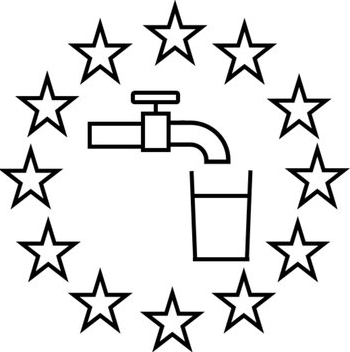
| Focus on European law: Marking specifications Marking equals a 5 mm-high symbol, paired with the words "Suitable for drinking water". The text appears in uppercase using the Helvetica Bold font. |

Why Europe reinforced its drinking water marking rules
The stakes rest on two main objectives: the reliability of materials and the protection of human health. Member states already require labels on certain products, so the principle feels familiar to industry players. What changes with the new law? The scope widens considerably, and the number of products covered by the obligation climbs compared to previous local standards.
It's also necessary to harmonise regulations across borders. Until now, manufacturers secured different authorisations for each EU country, which slowed commercialisation and multiplied administrative steps. A single EU declaration of conformity now replaces this patchwork. The benefits? Lighter administrative load, fewer authorisation issues, and wider access to the European market.

To whom do the new rules apply
The new framework involves a wide chain of actors:
- Manufacturers, importers, and authorised representatives: Responsible for products, testing, declarations of conformity and required markings
- Conformity assessment bodies: Audits, sample testing, and certificate issuance (valid for five years)
- Consumers: They exercise a fundamental right to access safe drinking water
The scope covers every member state of the European Union.
Over 60,000 professionals rely on Gravotech for high-performance marking solutions.
Need expert guidance on your project?
Contact our team
New European legislation: Key dates to remember
January 23, 2024: Formal adoption
The European Commission formally adopted the new minimum hygiene standards, together with delegated regulations that cover assessment procedures and labelling requirements.
April 2024: Official publication
The regulations were published in the Official Journal of the European Union, establishing the legal basis for the implementation timeline.
May 15, 2024: Official entry into force
The regulations took effect on the twentieth day after their publication, so officially on May 15, 2024.
December 31, 2026: General compliance
This date draws the hard line for labelling compliance. Every product intended for new installations or repair work must carry the required marking from this moment on.
December 31, 2032: Extended exception
An exception applies if products already met national requirements. If your national certificate remains valid on December 31, 2026, the compliance deadline extends to 2032.
What penalties apply for non-compliance with labelling requirements?
Non-compliance with the EU law on marking drinking water products may lead to administrative and commercial consequences.
- Market ban: Only products that meet hygiene requirements and carry the EU mark remain eligible for sale within the European Union.
- Certificate revocation: Annual inspections verify compliance. When production drifts from the standards between two audits, accrediting bodies revoke the certificate.
- Sanctions from accrediting bodies: Restrictions, suspension, or revocation of the right to practice apply in cases of non-compliance with obligations or requirements.
For manufacturers, the impact reaches critical areas of their business: sales performance, brand reputation, and operational continuity.
Meeting regulatory requirements: Gravotech's marking solutions
Laser technology performs exceptionally well for metal marking: stainless steel, copper, aluminium, and brass. It delivers permanent markings with high contrast, a real asset for visible components that end up in bathrooms, kitchens, or public spaces.
Parts in contact with drinking water rarely offer flat surfaces. Mixer taps, showerheads, valves… the geometry gets tricky: curves, cylinders, narrow recesses. Gravotech's accessories meet the marking needs of these parts (rotary device, 3D lens…). Its laser range covers this diversity:
- Laser stations (WeLase™, LW2, LW3; with rotary device): Class 1 safety-certified stations that mark individual parts or batches in a secure environment, well suited for showerheads and plumbing fixtures.
- Integrable lasers (Fibre, MOPA, Hybrid, Green, CO2; with 3D lens): Built for high-speed industrial production lines, these systems deliver non-contact marking with short cycle times, ideal for mass-produced valves or connectors.
The outcome? Clean, aesthetic markings, strong durability, zero consumables, and full integration into your production flow.
Small laser engraver for all kind of engravings.

WELASE
Discover this product
Medium fully automated laser marking station.

LW2
Discover this product
Large fully automated laser workstation with Fibre, Hybrid or Green sources

LW3
Discover this product
Integrated laser system to mark and engrave on all metals.

FIBRE laser
Discover this product
Integrated laser system for high-quality marking on metals and plastics.

MOPA Laser
Discover this product
Integrated laser system for high quality marking on plastics and metals.

HYBRID laser
Discover this product
Integrated laser system for high quality and cold marking on plastics and precious metals.

GREEN laser
Discover this product
Integrated laser system to mark organic materials.

CO2 laser
Discover this product
Dot peen relies on mechanical impact. A tungsten carbide stylus creates permanent markings through controlled micro-impacts. This technology earns its place on production lines thanks to its robustness and speed. It creates a deep-engraved groove that withstands the harshest industrial environments: abrasion, wear, corrosion. The marking lasts the entire life of the part, with no fading over time.
Available as standalone units (Impact) or integrated modules (XF510p, XF510m, XF530p/m) these machines guarantee lifelong legibility on pumps and taps. The stylus deforms the material without heat transfer, which keeps its mechanical properties fully intact.
Standalone dot peen marking station.

IMPACT
Discover this product
The fastest pneumatic dot peen marking machine.

XF510p
Discover this product
The most precise and consistent electromagnetic dot peen marking machine.

XF510m
Discover this product
Deep and permanent dot peen marking system.

XF530 p/m
Discover this product
Which Gravotech machine fits your compliance strategy?
The new EU law on marking drinking water products demands visible, clearly legible, and indelible labelling on every component in contact with drinking water. The right technology depends on your materials, your part geometries, and your production pace.
To stay aligned with these obligations, industrial companies that specialise in permanent marking solutions, such as Gravotech, can help manufacturers identify the most suitable marking technology depending on materials, geometries, and production constraints.
| Technology | Machines | Benefits | Applications (within the scope of the standards) | Limits | Price |
|---|---|---|---|---|---|
| Laser |
|
|
|
| $$-$$$ |
| Dot peen |
|
|
|
| $-$$ |
For manufacturers, the challenge is not only to apply the required symbol and wording, but also to choose a marking technology that fits their materials, part geometries, and production rates.
By anticipating the 2026 deadline, manufacturers can adapt their marking process early and secure compliance without disrupting production.
Gravotech can help identify the most suitable laser or dot peen solution for each industrial environment.


